Everything You Need to Know About Ischiogluteal Bursitis
What is Ischiogluteal Bursitis?
Ischiogluteal bursitis is when the bursa located between the sit bone (ischial tuberosity) and the gluteal muscles becomes inflamed or irritated. This small, fluid-filled sac is meant to reduce friction between tissues, but when it’s aggravated, often from sitting too long or overuse, it can cause buttock pain, especially when sitting or stretching the hamstring.
An analogy…
Think of a bursa like a small water balloon cushioning your muscles from the bone. If you sit or press on it too much, it gets squashed and inflamed, like sitting too long on a bruise.
What causes ischiogluteal bursitis?
The ischial bursa lies between the ischial tuberosity (your “sit bone”) and the gluteus maximus muscle. It becomes inflamed from repetitive friction or direct pressure, especially with activities that involve prolonged sitting, running, or hamstring stretching. This leads to pain, swelling, and discomfort over the lower buttock.
What are the signs and symptoms of ischiogluteal bursitis?
- Pain in the lower buttock, near the sit bone
- Worsens with sitting, especially on hard surfaces
- Pain with walking, running, or stretching the hamstrings
- Tenderness over the ischial tuberosity
- Pain may feel deep and dull, and sometimes mimic hamstring origin tendonitis
What tests are used to diagnose on ischiogluteal bursitis?
Palpation: Direct pressure over the sit bone reproduces symptoms
Stretching tests: Pain when stretching the hamstrings
How long does ischiogluteal bursitis take to heal?
Mild cases can improve in 2 to 4 weeks with rest and modification. More stubborn or chronic cases may take 6 to 8 weeks. Severe or misdiagnosed cases may persist for several months if not properly managed.
How does ischiogluteal bursitis happen?
- Prolonged sitting on hard surfaces
- Direct trauma to the buttocks
- Tight hamstrings pulling on the bursa
- Weak glutes or poor posture when sitting or standing
- Running or long-distance walking with poor technique
- Overuse or sudden increase in physical activity
What treatment can help ischiogluteal bursitis?
- Rest from aggravating activities
- Ice application in early stages to reduce inflammation
- Manual therapy (e.g. massage, dry needling, soft tissue release)
- Postural correction and sitting modifications
- Stretching and strengthening exercises to address muscular imbalances
What exercises or stretches can I do for ischiogluteal bursitis?
- Gentle hamstring and glute stretches
- Glute activation exercises
- Core stability drills
- Hip and postural strengthening
What products can help with ischiogluteal bursitis?
Piriformis stretch
Lie on your back and bend your affected knee.
Cross this leg over your other knee, placing the outside of your ankle just above the knee of your good leg.
Let the knee on your affected leg drop out to the side, and bend the good leg, sliding your heel towards your buttocks.
You may feel a stretch through your affected buttock.
To increase this stretch, interlace your fingers behind the thigh of your good leg, and pull your thigh in towards you, lifting the foot off the ground.
To increase this stretch further still, push your elbow into the thigh of your affected leg.
Hold this position.

Glute stretch – supine
Start position is lying on the back with the legs bent and the feet on the floor.
Lift one leg and cross that ankle over the opposite knee.
Reach between the legs grasping the back of the knee of the lower leg and then pull both legs in towards the chest.
The non-stretch leg should exert a slight pressure that assists in pushing the crossed leg upwards toward the chest.
Hold for as long as prescribed.
Hip extension and abduction raises in side lying
Lie down on your good side and roll your hip forward.
Use your elbows to support you.
Extend the upper leg straight back and rotate your foot down towards the floor. Flex your foot and lift the heel towards the ceiling, while keeping the extended leg straight.
Note that your leg is being lifted at an angle.
Keep your toes pointed down toward the floor.
Steadily return the leg to the starting position.
STOP GUESSING – START MOVING
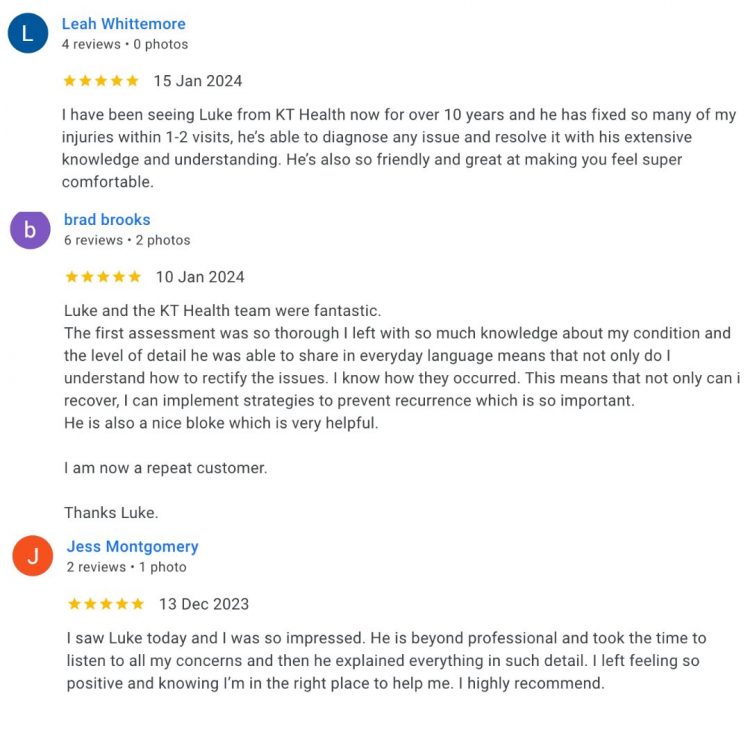
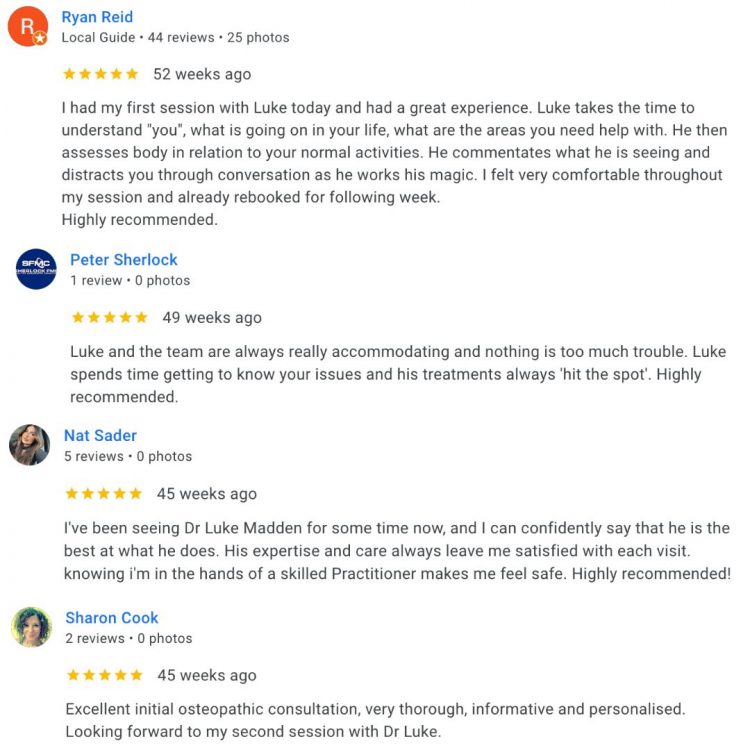
See what other people have said about our osteopaths
 Posted on Google
 Nick Batty18 November 2024
Trustindex verifies that the original source of the review is Google.
KT health has really helped my back and i have been able to get back into competitive sportPosted on Google Diane Mulholland15 November 2024Absolutely amazing, I see Louie Nouh who always listens and caters to my needs. He is amazing at his job and always helps alleviate my pain. I highly recommend Louie.Posted on Google
 Suzi Lowe11 November 2024Friendly, supportive staff. Such a lovely place to exercise! Highly recommend.Posted on Google
 Ann-Marie Graham22 October 2024Amazing instructor, I am new to Pilates felt very comfortable & supported.Posted on Google
 Sohan David20 October 2024I have been suffering from shoulder and neck pain for months - I saw Dr Louie Nouh a couple of time. His treatment really relived the pain. I have full range of movement now. His knowledge on exercise is fantastic.Posted on Google
 Alicia Brooks15 October 2024Absolutely love reformer at menai. Instructors are amazing. Love Michaela and love the small classes. Highly recommend!Posted on Google
 Jasmine Tompson15 October 2024The trainers are all amazing , they explain everthing step by step and help where needed . It is an amazing place to relax get to know other people have a laugh . I recommend for anyone .Posted on Google
 Jamie Mezrani15 October 2024Ever since I came here I’ve been looked after by Louie and my shoulder is already feeling much better. Highly Recommend these are good people.Posted on Google
 Glenn Leal9 October 2024SENSATIONAL Chiropractor in Menai! I attended my first appointment with Dr Louis Nouh at KT Health & Wellness who is an absolute genius even after one session with him. He explained everything he intended to address about my lower back condition, all in easy to understand, layman’s terms. He said he would call me the next day to follow and see how I was feeling after our session and guess what, he did! During our session, he made me feel relaxed and comfortable especially as it was my first chiropractic appointment EVER! For some reason, I am actually looking forward to my subsequent sessions with him next week. Don’t get me wrong, he did poke, prod and crack me as necessary but the results made it seem worth it.Posted on Google
 Colleen Howe29 September 2024I have been seeing Melinda now for a couple of months to help with bursitis in my hip. She is one of the best practitioners I’ve ever seen.. With the use of various tools and techniques she has helped me recover much quicker than I expected. Thanks Mel and see you tomorrow!