Everything You Need to Know About Hip Arthritis
What is Hip Arthritis?
Hip arthritis is when the cartilage that cushions the hip joint wears down, causing the bones to rub against each other. This leads to pain, stiffness, swelling, and reduced movement in the hip. It usually develops gradually over time, but can sometimes be triggered after injury or heavy joint loading.
An analogy…
Imagine your hip joint like a hinge with smooth padding. Over time, if that padding wears away, the metal parts grind together, causing damage and stiffness, that’s what happens in arthritis.
What are other names that hip arthritis can be called?
Hip Osteoarthritis, Osteoarthritis of the Hip, Arthritis of the Hip, Degeneration of the Hip
What causes hip arthritis?
The hip joint is a ball-and-socket joint where the femoral head (ball) fits into the acetabulum (socket) of the pelvis. These surfaces are normally covered by smooth cartilage. In arthritis, the cartilage breaks down, the joint space narrows, and bone spurs (osteophytes) can form. This leads to painful friction, inflammation, and loss of normal joint movement.
What are the signs and symptoms of hip arthritis?
- Pain deep in the groin or hip, often worse after activity
- Stiffness, especially after sitting or waking up in the morning
- Reduced range of motion (difficulty bending, rotating, or putting on shoes)
- Aching or sharp pain that can radiate to the thigh or buttocks
- Grinding, clicking, or locking sensations in the hip
- Difficulty walking, standing, or climbing stairs
What tests are used to diagnose hip arthritis?
Palpation: Checking for tenderness around the hip joint
Range of motion tests: Assessing stiffness and pain during hip movement
FABER Test: Flexing, abducting, and externally rotating the hip to see if it reproduces groin pain
How long does hip arthritis take to heal?
Mild to moderate cases can improve in 6 to 12 weeks with proper management and exercise. Severe cases may need ongoing management for months or years.
How does hip arthritis happen?
- Aging
- Previous hip injuries
- Repetitive strain from heavy lifting or high-impact sports
- Genetic predisposition
- Hip joint abnormalities
What treatment can help hip arthritis?
- Manual therapy (joint mobilisation, soft tissue release, massage)
- Exercise programs to strengthen the glutes, core, and hips
- Stretching tight muscles around the hip
- Activity modification
- Use of walking aids (cane or stick)
What exercises or stretches can I do for hip arthritis?
- Glute strengthening
- Hip flexor and hamstring stretches
- Gentle range of motion exercises
- Core strengthening
- Balance and stability drills to protect the hip
- Low-impact aerobic exercises
What products can help with hip arthritis?
Resisted hip flexion (standing)
Stand up straight and hold onto a supportive surface.
Place a resistance band around the ankle on your affected leg.
Stand firmly on the other end of the resistance band.
Lift your leg up in front of you, bending your knee.
You should feel the effort at the front of the hip against the resistance band.
Slowly lower your leg back down.

Lateral hip rotation
Stand tall with your feet hip-width apart, your knees slightly bent and your hips back.
Lift one knee into the air and laterally rotate your hip.
Repeat the movement with your other leg.
Continue alternating the movement to complete the set.
Supine knee hugs
Lie on your back.
Draw one foot up and then the other.
Bring one knee in towards your chest and then the other, using your hands for assistance to curl yourself in to a ball.
Glute Bridges
Lie on your back with your legs bent and your feet flat on the floor.
Exhaling, lift your pelvis off the mat and move up into the Pelvic Curl position with your shoulders and arms pressing onto the mat.
This will be your starting position.
INHALE: raise one leg upwards, keeping your knee bent at 90 degrees, with the foot Plantar flexed (pointed).
EXHALE: lower your leg down and tap the floor with your toes.
INHALE: raise the same leg up, keeping a consistent angle at the knee.
EXHALE: lower your leg down, keeping your pelvis absolutely stable.
Continue on for the desired number of repetitions and repeat the movement with your other leg.
Keep your body stable as your leg hinges at the hip joint.
Maintain your pelvis at the same height throughout.
Squats
Squatting helps to strengthen the quadriceps muscle that is very important for many daily activities such as sitting down and standing up from a chair, walking, and climbing stairs.
Stand upright with a chair behind you, and your arms out in front of you for balance.
Bend your knees, pushing your hips back behind you and leaning your body forwards, as though you are about to sit on the chair.
Come as close as you can to the chair without actually sitting on it and make sure that you do not feel unbalanced.
Be careful to keep your legs away from the back of the chair, so they don’t press against it.
Stand back up, squeezing your buttock muscles to help with the movement.
Repeat the exercise, making sure you keep your back straight throughout.
STOP GUESSING – START MOVING
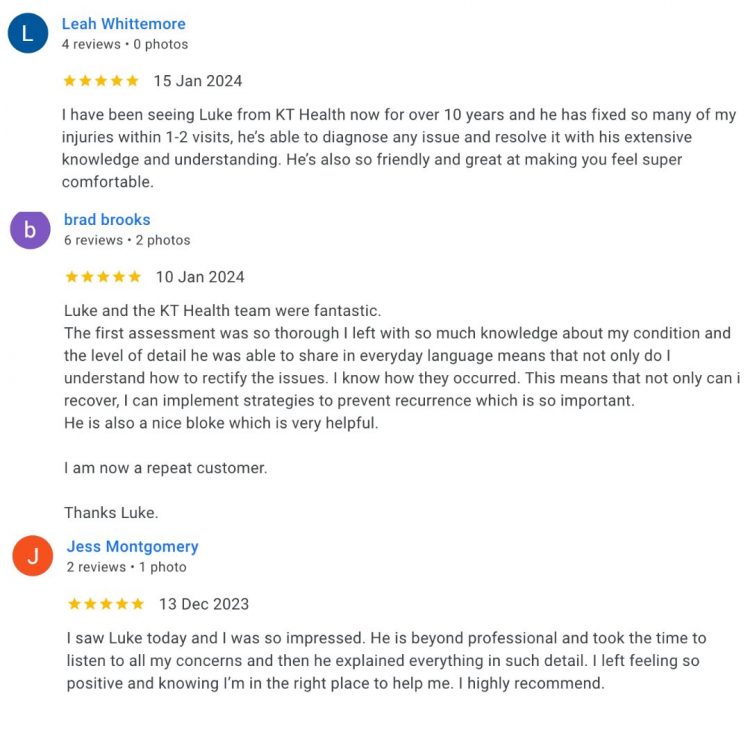
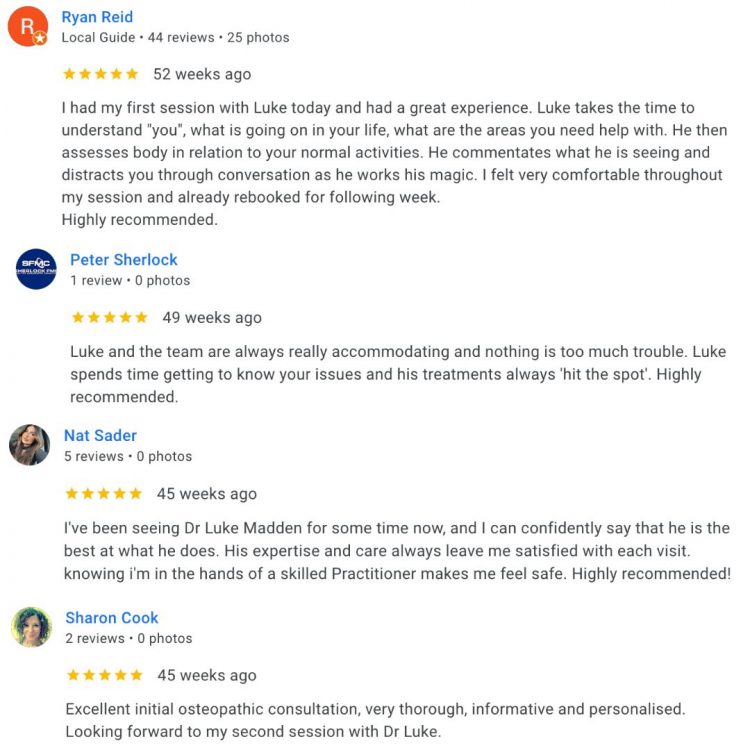
See what other people have said about our osteopaths
 Posted on Google
 Nick Batty18 November 2024
Trustindex verifies that the original source of the review is Google.
KT health has really helped my back and i have been able to get back into competitive sportPosted on Google Diane Mulholland15 November 2024Absolutely amazing, I see Louie Nouh who always listens and caters to my needs. He is amazing at his job and always helps alleviate my pain. I highly recommend Louie.Posted on Google
 Suzi Lowe11 November 2024Friendly, supportive staff. Such a lovely place to exercise! Highly recommend.Posted on Google
 Ann-Marie Graham22 October 2024Amazing instructor, I am new to Pilates felt very comfortable & supported.Posted on Google
 Sohan David20 October 2024I have been suffering from shoulder and neck pain for months - I saw Dr Louie Nouh a couple of time. His treatment really relived the pain. I have full range of movement now. His knowledge on exercise is fantastic.Posted on Google
 Alicia Brooks15 October 2024Absolutely love reformer at menai. Instructors are amazing. Love Michaela and love the small classes. Highly recommend!Posted on Google
 Jasmine Tompson15 October 2024The trainers are all amazing , they explain everthing step by step and help where needed . It is an amazing place to relax get to know other people have a laugh . I recommend for anyone .Posted on Google
 Jamie Mezrani15 October 2024Ever since I came here I’ve been looked after by Louie and my shoulder is already feeling much better. Highly Recommend these are good people.Posted on Google
 Glenn Leal9 October 2024SENSATIONAL Chiropractor in Menai! I attended my first appointment with Dr Louis Nouh at KT Health & Wellness who is an absolute genius even after one session with him. He explained everything he intended to address about my lower back condition, all in easy to understand, layman’s terms. He said he would call me the next day to follow and see how I was feeling after our session and guess what, he did! During our session, he made me feel relaxed and comfortable especially as it was my first chiropractic appointment EVER! For some reason, I am actually looking forward to my subsequent sessions with him next week. Don’t get me wrong, he did poke, prod and crack me as necessary but the results made it seem worth it.Posted on Google
 Colleen Howe29 September 2024I have been seeing Melinda now for a couple of months to help with bursitis in my hip. She is one of the best practitioners I’ve ever seen.. With the use of various tools and techniques she has helped me recover much quicker than I expected. Thanks Mel and see you tomorrow!