
Everything You Need to Know About Iliotibial Band Syndrome
What is Iliotibial Band Syndrome?
Iliotibial Band Syndrome (ITBS) is a condition where the iliotibial band, a thick band of connective tissue running down the outside of your thigh, becomes tight and irritated, causing pain on the outer part of the knee. It’s most common in runners, cyclists, and people who do repetitive leg movements.
An analogy…
Imagine a piece of rope constantly rubbing over a metal pole. Eventually, it frays or heats up. That’s what happens when the iliotibial band rubs against the outside of your thigh bone near the knee, leading to irritation and inflammation.
What are other names that iliotibial band syndrome can be called?
- Iliotibial Syndrome
- ITB Syndrome
- Runner’s Knee (when referring to pain on the outer side)
- Iliotibial Band Friction Syndrome
What causes iliotibial band syndrome?
- Overuse
- Tight or weak hip muscles
- Poor foot or knee alignment
- Running on uneven surfaces
- Sudden increase in training intensity or distance
What are the signs and symptoms of iliotibial band syndrome?
- Sharp or burning pain on the outer side of the knee
- Pain worsens with running, especially downhill or long distances
- Tenderness or tightness along the outer thigh
- Pain that starts during a workout and eases with rest
- Clicking or snapping sensation on the outside of the knee
- Tight hips or glutes may also be present
What tests are used to diagnose iliotibial band syndrome?
Ober’s Test: Assesses IT band tightness when the leg is lowered from the side.
Noble’s Compression Test: Reproduces pain when pressure is applied over the ITB near the knee during movement.
Functional assessment: Evaluates hip/knee control during activities like squatting or running.
How long does iliotibial band syndrome take to heal?
Mild cases may resolve in 2 to 4 weeks with rest and rehab. Moderate to severe cases may take 6 to 12 weeks or longer. If ignored or poorly managed, it can become chronic and take months to fully settle.
How does iliotibial band syndrome happen?
- Weak glutes or hip stabilisers
- Tight IT band or TFL (tensor fascia lata)
- Poor running technique or excessive mileage
- Wearing worn-out shoes or poor footwear
- Imbalances between left and right legs
What treatment can help iliotibial band syndrome?
- Rest or reduce aggravating activity (especially running or cycling)
- Ice the outside of the knee
- Manual therapy (massage, dry needling, and foam rolling)
- Stretching the IT band, glutes, and hip flexors
- Strength training for glutes, hips, and core
- Shockwave therapy or corticosteroid injections
What exercises or stretches can I do for iliotibial band syndrome?
- Side-lying leg lifts
- Bridges with band resistance
- Foam rolling the outer thigh (IT band and quads)
- IT band stretch (cross one leg behind the other and lean sideways)
- Standing or lying glute stretches
- Clamshells with a resistance band
What products can help with iliotibial band syndrome?
Clam shells
Lie on your side with your feet, ankles and knees together.
Bend the legs a little and tighten your core stability muscles.
Keeping the feet together, lift the top knee up.
Make sure you don’t roll your body back with the movement.
Control the movement as you bring the knee back down to the starting position.

Gluteal muscle stretch
Lie on your back in a comfortable position.
Now, bring one knee up towards your opposite shoulder.
You should feel a comfortable stretch, not pain, in your deep buttock muscles.
To increase the stretch push your flexed hip gently downwards.
Maintain this position for as long as prescribed.
Hip flexor stretch
Stand up straight next to a wall or supporting surface.
Take a large step backwards with your affected leg.
Keep your back heel slightly off the ground with the knee soft.
Slowly lower your back knee towards the ground while pushing your pelvis forwards.
Keep your body upright.
You should feel the stretch at the front of the back hip.
Hold this position.
Single leg stance
Stand on your affected leg close to a wall or supporting surface.
Try to balance as still as you can.
Hold this position for as long as possible.
Do not allow the good leg to rest on the affected leg.
Windmill
Start position is standing in a wide stance with the arms stretched out to the side at shoulder level height.
Move into a semi-squat and hold when arms can touch the floor, then rotate at the hips and the trunk to reach the arms toward the opposite foot.
Stay balanced, with slightly more weight on the side of the reach and keep the head and chest up and aligned.
STOP GUESSING – START MOVING
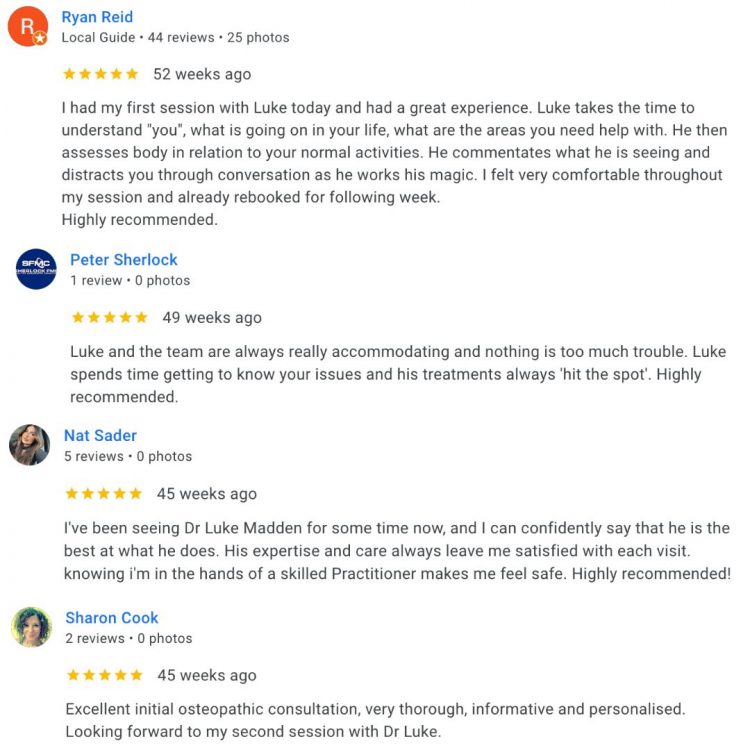
See what other people have said about our osteopaths
Trustindex verifies that the original source of the review is Google. KT health has really helped my back and i have been able to get back into competitive sportTrustindex verifies that the original source of the review is Google. Absolutely amazing, I see Louie Nouh who always listens and caters to my needs. He is amazing at his job and always helps alleviate my pain. I highly recommend Louie.Trustindex verifies that the original source of the review is Google. Friendly, supportive staff. Such a lovely place to exercise! Highly recommend.Trustindex verifies that the original source of the review is Google. Amazing instructor, I am new to Pilates felt very comfortable & supported.Trustindex verifies that the original source of the review is Google. I have been suffering from shoulder and neck pain for months - I saw Dr Louie Nouh a couple of time. His treatment really relived the pain. I have full range of movement now. His knowledge on exercise is fantastic.Trustindex verifies that the original source of the review is Google. Absolutely love reformer at menai. Instructors are amazing. Love Michaela and love the small classes. Highly recommend!Trustindex verifies that the original source of the review is Google. The trainers are all amazing , they explain everthing step by step and help where needed . It is an amazing place to relax get to know other people have a laugh . I recommend for anyone .Trustindex verifies that the original source of the review is Google. Ever since I came here I’ve been looked after by Louie and my shoulder is already feeling much better. Highly Recommend these are good people.Trustindex verifies that the original source of the review is Google. SENSATIONAL Chiropractor in Menai! I attended my first appointment with Dr Louis Nouh at KT Health & Wellness who is an absolute genius even after one session with him. He explained everything he intended to address about my lower back condition, all in easy to understand, layman’s terms. He said he would call me the next day to follow and see how I was feeling after our session and guess what, he did! During our session, he made me feel relaxed and comfortable especially as it was my first chiropractic appointment EVER! For some reason, I am actually looking forward to my subsequent sessions with him next week. Don’t get me wrong, he did poke, prod and crack me as necessary but the results made it seem worth it.Trustindex verifies that the original source of the review is Google. I have been seeing Melinda now for a couple of months to help with bursitis in my hip. She is one of the best practitioners I’ve ever seen.. With the use of various tools and techniques she has helped me recover much quicker than I expected. Thanks Mel and see you tomorrow!

We don't offer magic fixes or cures, but a sustainable approach to back pain.
Our Osteopaths will offer you a road map to help you take control of your back pain and feel great again.
BOOK YOUR OSTEOPATH VISIT TODAY
Book a Time with Dr Luke Madden Below
Book a Time with Dr Melinda Madden Below
Already have an account?
Book as a guest
- Book an Appointment