
Everything You Need to Know About Knee Arthroscopy
What is Knee Arthroscopy?
Knee arthroscopy is a minimally invasive surgical procedure used to diagnose and treat problems inside the knee joint. A surgeon inserts a small camera (arthroscope) and tiny surgical tools through small incisions to look at the structures inside the knee and fix any damage such as trimming a torn meniscus, smoothing cartilage, or removing loose fragments.
An analogy…
Think of your knee like a car engine with a dashboard camera. Instead of opening the whole engine, the mechanic uses a camera and small tools through keyholes to check inside and fix the problem. That’s what arthroscopy is; keyhole surgery for your knee.
What are other names that knee arthroscopy can be called?
- Knee Scope
- Arthroscopic Knee Surgery
- Keyhole Knee Surgery
- Minimally Invasive Knee Surgery
What causes knee arthroscopy to be needed?
Knee arthroscopy is usually done when other treatments haven’t worked, or when a clear diagnosis or repair is needed. Common reasons include:
- Meniscus tears
- Cartilage damage
- Loose bone or cartilage fragments
- Ligament injuries (e.g. partial ACL tears)
- Inflammation in the joint lining
- Persistent swelling, locking, or clicking
What are the signs and symptoms that might lead to knee arthroscopy?
- Ongoing knee pain, especially deep inside the joint
- Swelling or inflammation that doesn’t settle with rest
- Locking or catching when you bend or straighten your knee
- Instability or giving way
- Clicking or grinding sounds
- Limited range of motion or stiffness
- Poor response to physio, rest, or medication
What tests are used to diagnose issues that need knee arthroscopy?
- Physical assessment: checking joint movement, pain, and instability
- MRI scan: shows soft tissue injuries (e.g. meniscus, cartilage, ligaments)
- X-ray: to rule out arthritis or fractures
- If imaging is unclear or doesn’t match symptoms, arthroscopy may be used to look inside directly
How long does knee arthroscopy take to heal?
Recovery depends on what was done during the surgery:
- Simple clean-out or inspection: 2–4 weeks
- Meniscus trimming or cartilage smoothing: 4–6 weeks
- More complex procedures (e.g. ligament repair): 8–12+ weeks
Most people return to normal daily activities within 1–3 weeks, and sports or heavy activity in 6–12 weeks, depending on rehab.
How does knee arthroscopy happen?
You’re usually given a local or general anaesthetic. The surgeon makes 2–3 small cuts around your knee, inserts a camera, and uses fine instruments to assess or treat the problem. The knee is then flushed with sterile fluid, the tools are removed, and the incisions are closed with small stitches or tape. You often go home the same day.
What treatment can help after knee arthroscopy?
- Rest and ice in the first 48–72 hours
- Elevation to reduce swelling
- Gentle movement (heel slides, quad activation) to prevent stiffness
- Manual therapy to reduce swelling and restore motion
- Progressive strengthening exercises (quads, glutes, hamstrings)
- Walking with crutches if needed early on
- Physiotherapy to guide rehab and prevent compensation patterns
- Return to activity gradually, based on your recovery and what was done during the procedure
What exercises or stretches can I do after knee arthroscopy?
- Quad sets (tightening thigh muscle)
- Heel slides to improve knee bending
- Straight leg raises
- Bridges for glute and hamstring activation
- Knee extensions and mini-squats
- Step-ups and balance work
- Cycling on a stationary bike
What products can help with knee arthroscopy?
Quad activation in long sit
Start in a seated position with your legs stretched out in front of you with a towel under your affected knee.
Keep your toes upwards and extend your knee by tightening your thigh muscles.

Straight Leg Raises (SLR)
Sit with your resting leg bent and pull your toes up towards you.
Tighten your thigh muscle, pressing the back of your knee into the floor.
Keeping your knee locked straight, lift your leg off the floor.
Hold this position before you return your leg to the floor.
Make sure your hips remain in contact with the floor at all times, and your knee remains straight.
Heel slides
Lie on your back with your legs straight.
Bend the symptomatic leg as far as you can, sliding your heel towards your buttocks, keeping the knee pointing to the ceiling throughout this movement.
Slide the heel back down, reversing the movement until your leg is straight again.
AROM ankle circumduction
Lie down on your back with your legs straight out in front of you.
Make clockwise circles with your ankles, then change direction to make anticlockwise circles.
Active knee flexion in sitting
Sitting up straight in a chair, bend your symptomatic knee, pulling your heel back under the chair.
Wall squats
Lean against a wall, with your feet away from the wall and shoulder width apart.
Your back and buttocks should remain in contact with the wall throughout.
Slide down the wall, aiming to reach horizontal with your thighs.
Your knees should be at 90 degrees at this point.
Push yourself back up the wall, driving the movement with your buttock muscles.
STOP GUESSING – START MOVING
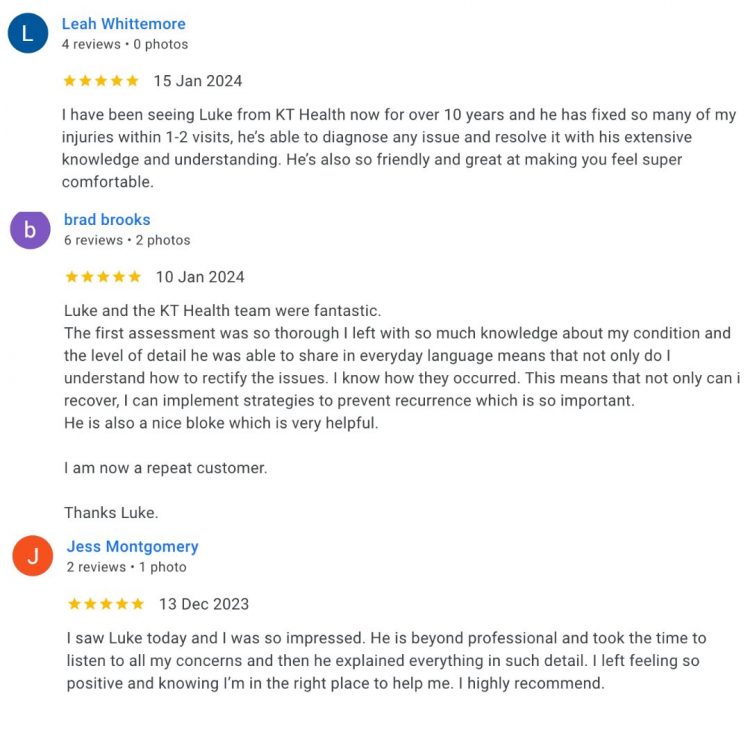
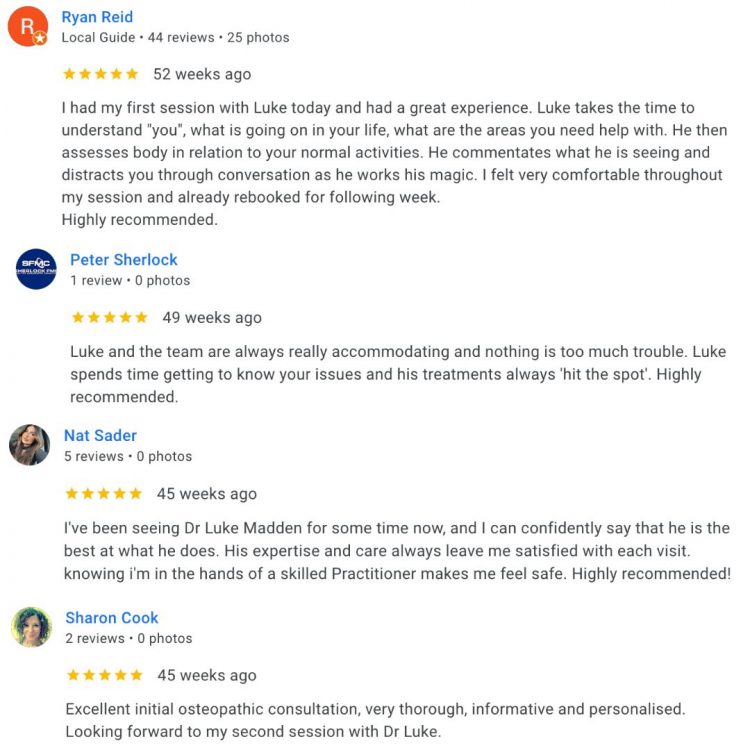
See what other people have said about our osteopaths
Trustindex verifies that the original source of the review is Google. KT health has really helped my back and i have been able to get back into competitive sportPosted onTrustindex verifies that the original source of the review is Google. Absolutely amazing, I see Louie Nouh who always listens and caters to my needs. He is amazing at his job and always helps alleviate my pain. I highly recommend Louie.Posted onTrustindex verifies that the original source of the review is Google. Friendly, supportive staff. Such a lovely place to exercise! Highly recommend.Posted onTrustindex verifies that the original source of the review is Google. Amazing instructor, I am new to Pilates felt very comfortable & supported.Posted onTrustindex verifies that the original source of the review is Google. I have been suffering from shoulder and neck pain for months - I saw Dr Louie Nouh a couple of time. His treatment really relived the pain. I have full range of movement now. His knowledge on exercise is fantastic.Posted onTrustindex verifies that the original source of the review is Google. Absolutely love reformer at menai. Instructors are amazing. Love Michaela and love the small classes. Highly recommend!Posted onTrustindex verifies that the original source of the review is Google. The trainers are all amazing , they explain everthing step by step and help where needed . It is an amazing place to relax get to know other people have a laugh . I recommend for anyone .Posted onTrustindex verifies that the original source of the review is Google. Ever since I came here I’ve been looked after by Louie and my shoulder is already feeling much better. Highly Recommend these are good people.Posted onTrustindex verifies that the original source of the review is Google. SENSATIONAL Chiropractor in Menai! I attended my first appointment with Dr Louis Nouh at KT Health & Wellness who is an absolute genius even after one session with him. He explained everything he intended to address about my lower back condition, all in easy to understand, layman’s terms. He said he would call me the next day to follow and see how I was feeling after our session and guess what, he did! During our session, he made me feel relaxed and comfortable especially as it was my first chiropractic appointment EVER! For some reason, I am actually looking forward to my subsequent sessions with him next week. Don’t get me wrong, he did poke, prod and crack me as necessary but the results made it seem worth it.Posted onTrustindex verifies that the original source of the review is Google. I have been seeing Melinda now for a couple of months to help with bursitis in my hip. She is one of the best practitioners I’ve ever seen.. With the use of various tools and techniques she has helped me recover much quicker than I expected. Thanks Mel and see you tomorrow!
We don't offer magic fixes or cures, but a sustainable approach to back pain.
Our Osteopaths will offer you a road map to help you take control of your back pain and feel great again.
BOOK YOUR OSTEOPATH VISIT TODAY
Book a Time with Dr Luke Madden Below
Book a Time with Dr Melinda Madden Below
Already have an account?
Book as a guest
- Book an Appointment